Cooking Louisiana - Sharpening Knives
|
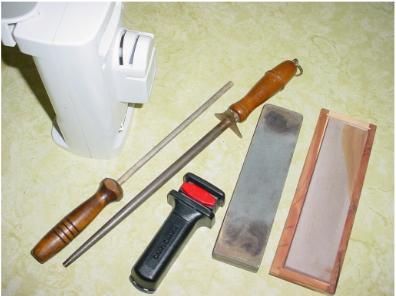
Knife Sharpeners come in many forms. Below from left to right are... The can-opener, the ceramic stick, the steel, a new fangled diamond sharpener, a whet stone and a whet rock (a soft Arkansas stone). The stones and steels are the old standard and as you'll see below technology has brought us quite a way in knife sharpening.
The can-opener and whet stone (1st and 5th) are the edge "shapers" (rough knife edge cutting). The sticks and the Arkansas stone are hones, which means they bring the rough edge made by the shapers to the final (fine) cutting edge. Simply explained the shapers take away big particles of steel on the knife's edge and the hones take away very small particles of steel. The new fangled sharpener has two sharpening areas. One is a shaper and one is a hone (if you get one just read the instructions). The process takes passing the knife on one side of the red piece (the shaper) several times and the second process brings the edge through the final honing process. The sharpening process is really simple. You actually create two edges on a knife. the first edge is a slim angle and the second is a less slim angle (the honing).
You can read more... Click Here.
In any case, learn to use one method that gives you the result you want and stick with it. No matter what type of sharpening tools you use you must stay with it. If you switch from the whet stone to the new fangled sharpener the edge of your knife will take on a slightly different shape, and, changing that shape takes a little elbow grease! The traditional sharpening methods use a whet stone to shape and a whet rock to hone. Hey, those knives are very sharp and will cut you to the bone. Unfortunately the knife doesn't know the difference between your finger and an onion! Be Careful! Oh by the way, the word "whet" means "to make sharper or keener" not to run the hose on something or give it a bath! If you want to get really technical with this here is one site that goes into the REAL theory! (click here)
|
|
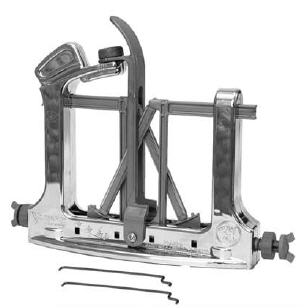 Here's
a new type of sharpener that I own and since using it I've abandoned
all the other methods of sharpening knives. The gadget to the right
is a Warthog V-Sharp XE. It applies a constant edge angle and
constant sharpening pressure which are required to get a really
sharp knife. Those two attributes combined with diamond sharpening
rods makes this sharpener the "King of Sharpeners".
Here's
a new type of sharpener that I own and since using it I've abandoned
all the other methods of sharpening knives. The gadget to the right
is a Warthog V-Sharp XE. It applies a constant edge angle and
constant sharpening pressure which are required to get a really
sharp knife. Those two attributes combined with diamond sharpening
rods makes this sharpener the "King of Sharpeners".